Quick answer: Yes. Retiring does not cancel your mortgage, and you keep paying under your current contract, but at 70 the monthly payment has to fit a fixed retirement income. Options include refinancing, selling or a reverse mortgage. A reverse mortgage pays off the existing mortgage and requires no monthly payments, while interest accrues and reduces your home equity.
You may want to stay in the home you know. The question is how to make the monthly budget work. Let's look at your options.
Can you still have a mortgage at 70? Start with the monthly picture
Make a simple list of what leaves your account each month:
- Your mortgage payment
- Any HELOC payment, meaning a payment on a home equity line of credit
- Credit card or car loan payments
- Property taxes, home insurance and regular home upkeep
- The income you can count on, such as pensions or other retirement income
This is not a test. It shows what is creating the pressure. If your home is valuable but your monthly income is limited, you have equity in the house without much cash to use.
Option one: Keep making your current payments
If your income comfortably covers the mortgage and other costs, staying with your current loan may be the simpler choice.
Comfort is the key word. If you are regularly dipping into savings, carrying credit card balances, or worrying about the next payment, review the budget instead of hoping the squeeze eases on its own.
A mortgage renewal after retirement is a moment to pause and review, not just sign. A refinance replaces your mortgage with a new one. It can change the payment, but you need to qualify on your retirement income, and a longer repayment period means paying interest for longer. If the new payment would still stretch your income, refinancing may not solve the problem.
Option two: Sell and move to a smaller home
Selling turns your home equity into cash and ends the mortgage. Moving to a smaller home or a rental may also reduce some housing costs.
This choice is about more than numbers. You may be leaving neighbours, routines, family nearby, or a home that has mattered for decades. In Vancouver or Victoria, a smaller home does not automatically mean a lower overall cost once moving, legal and purchase or rental costs are counted.
Selling makes sense if you already want a change. It fits less well if your main goal is to stay put.
Option three: A reverse mortgage at 70
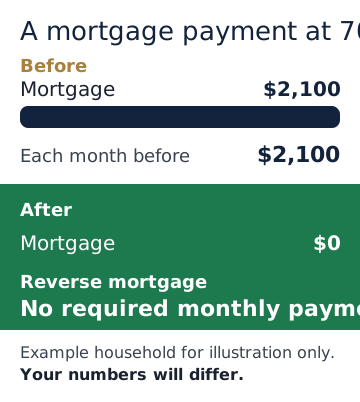
A reverse mortgage is a loan secured against your home for homeowners 55 and older. The funds pay off your existing mortgage first, and can also clear other debts.
You stay on title as the homeowner. The loan is repaid when the home is sold, you move out permanently, or the last borrower dies.
No regular monthly mortgage payments are required. You still keep up property taxes, home insurance and upkeep.
That makes a reverse mortgage worth a close look if your mortgage payment takes too much of your retirement income and you want to stay at home. Interest accrues over time and reduces your home equity. To see roughly how much equity your home could provide, try the BC reverse mortgage calculator.
A reverse mortgage may not fit if you expect to move soon, or if the amount available would not cover the mortgage payout. Our reverse mortgage pros and cons guide walks through both sides.
Compare the options around your goal
The decision is not simply "Which loan can I get?" It is "Which choice supports the life I want?"
- Would keeping my current mortgage leave enough for regular expenses?
- Could I qualify for a refinance and manage its payments?
- Would selling and moving suit me?
- Would reverse mortgage funds cover the mortgage payout?
- What happens if I later need to move or want to sell?
Local home values matter too. See our city guides for reverse mortgages in Vancouver and reverse mortgages in Victoria.
Bring family into the conversation
A reverse mortgage affects the equity left when the home is sold or passed on. That does not mean your family decides for you. A family conversation helps everyone understand the plan and avoids surprises. If a spouse lives with you, ask how the agreement affects them, and have a lawyer review the documents before you sign.
The BC Retirement Cash-Flow Reset
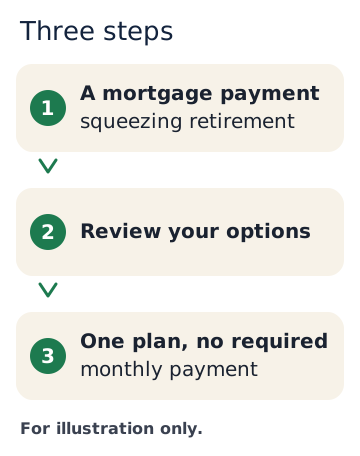
If you are still paying a mortgage at 70 in Vancouver or Victoria, you have choices. The BC Retirement Cash-Flow Reset is a free 14-Day Payment Freedom Review for homeowners 65 and older. You get a call back within one business day, a written plan within 14 days of sending your documents, and a straight answer if a reverse mortgage is not a fit.
Take the 60-second BC Reverse Mortgage Quiz
Matt Blake, Mortgage Broker (BCFSA Licence MB600487).
BRX Mortgage Inc. (BCFSA Licence X301291).