Quick answer: Yes. In BC, homeowners 55 and older can use a reverse mortgage to pay off credit card debt and a HELOC. Any HELOC registered on the home is paid out first, then other debts can be cleared. Those monthly payments stop. Interest accrues over time and reduces your home equity, and you keep paying property taxes, insurance and maintenance.
Let's break down how this could work, what it may change in your monthly budget, and what to weigh before you decide.
Using a reverse mortgage to pay off credit card debt: what changes?
A HELOC is a loan secured by your home. You make payments on the amount you borrow. Credit card debt is not secured by your home, but its payments can still take a large bite out of your monthly income.
A reverse mortgage is also secured by your home. Instead of making regular mortgage payments, you borrow against some of your home equity, and the loan balance grows over time. The funds can be used to pay off some or all of your HELOC and credit card balances.
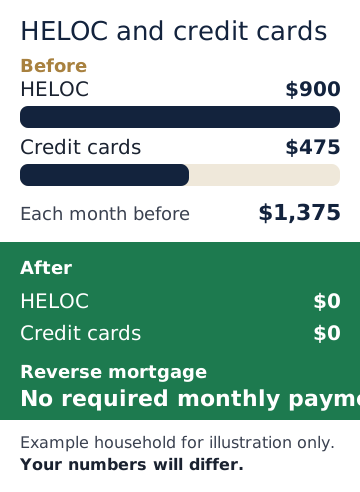
The debt does not disappear. It moves into one new loan secured by your home, with no monthly payment.
No regular monthly mortgage payments are required. You still keep up property taxes, home insurance and upkeep.
Removing the HELOC and credit card payments can free up income for groceries, utilities, prescriptions, home repairs and other day-to-day needs. Whether it fits depends on your home, your debts and your plans. Our guide to using a reverse mortgage to pay off debt in retirement covers mortgages and other debts too.
How the process works
Imagine you are a BC homeowner in Vancouver, Victoria or anywhere else in the province. Your retirement income is steady, but you are still paying your HELOC and making credit card payments. You want to stay in your home, but the monthly bills leave little room for surprises.
Here is how a conversation about a reverse mortgage usually unfolds:
- List the debts and payments. Gather your latest HELOC statement and credit card balances. Note each monthly payment and any other debts.
- Review the home and existing loans. The amount available depends on your age, your home and where it is. If your HELOC is registered against the home, it must be paid out as part of the arrangement.
- Decide which debts get paid. A good plan shows which balances are cleared and which payments stop. Ask how fees and loan costs are handled.
- Look at the new balance over time. Understand how interest is added and what makes the loan come due.
Borrow what the plan needs. Paying off only the credit cards may not change enough if the HELOC payment is still squeezing your budget. Borrowing more than you need means interest builds on money you did not have to take.
Paying off a HELOC with a reverse mortgage: the cash-flow benefit and the trade-off
The benefit is simple: when reverse mortgage funds pay off debts that require monthly payments, your retirement budget gets breathing room.
The trade-off is cost. Interest accrues over time and reduces your home equity. The loan is repaid when the home is sold, you move out, or the last borrower dies. There can also be appraisal, legal, setup or early repayment costs, so ask which ones apply.
The Financial Consumer Agency of Canada suggests comparing other options before you get a reverse mortgage, and says you may wish to speak with a financial advisor and with your family first. If you already have a HELOC, our reverse mortgage vs HELOC comparison shows how the two differ side by side.
Compare it with other ways to manage the payments
A reverse mortgage is one option. Before deciding, consider whether:
- A regular mortgage refinance could combine the debts into a payment that fits your retirement income.
- A repayment plan for the credit card balances could ease the pressure without borrowing against the home.
- Your HELOC terms can be changed so the payments are manageable.
- Selling or downsizing would suit you better.
A refinance still means monthly payments, and you have to qualify on your income. Selling means leaving the home. A reverse mortgage removes the monthly payment, and its balance grows over time.
Questions to ask before you decide
- Which HELOC and credit card balances would be paid off?
- Would my HELOC need to be closed?
- What fees would I pay, and would any be added to the loan balance?
- How does interest build over time?
- When would the reverse mortgage become due under my contract?
- What happens if I want to sell or move?
- How might this affect a spouse who lives with me?
Talk it over with family, and get independent legal advice before signing. For a quick estimate of what your home could provide, try the BC reverse mortgage calculator.
A clear look at the monthly budget
If HELOC and credit card payments are squeezing your retirement income, a reverse mortgage is worth a look as a cash-flow strategy. It turns some of your home equity into funds that clear those debts, while you stay in your home.
Take the 60-second BC Reverse Mortgage Quiz
Matt Blake, Mortgage Broker (BCFSA Licence MB600487).
BRX Mortgage Inc. (BCFSA Licence X301291).