Quick answer: No. A reverse mortgage has no required monthly payments. Interest is added to the balance instead, and the loan is repaid when you sell, move out, or the last borrower dies. Interest accrues over time and reduces your home equity. You still pay property taxes, home insurance and maintenance, and you can usually choose to make payments.
Your retirement income arrives on a steady schedule. The bills do too. If you are in your late sixties or early seventies and still paying a mortgage, a home equity line of credit, credit cards or a car loan, those payments can leave little room in the month.
A reverse mortgage lets you use part of the value built up in your home to repay those debts, so their monthly payments stop. Let's walk through what that means.
Why debt payments feel heavier when you are retiring with debt
A fixed income makes planning easier in one way: you know what is coming in. It also makes a surprise repair, a rising bill, or several debt payments harder to manage.
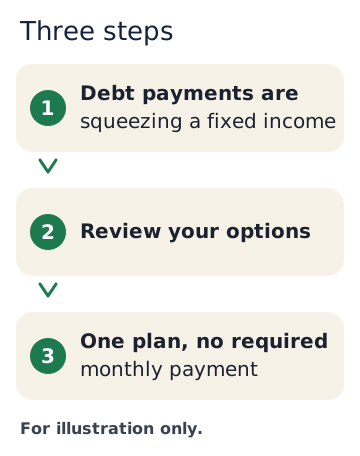
Picture the month starting with a mortgage payment, a credit card bill, a car loan payment and the regular costs of running your home. Each one may be manageable on its own. Together, they squeeze groceries, health costs, home repairs and time with family.
Often the issue is not too little home value. It is that the value is tied up in the property while the payments come out of your income.
Do you have to make monthly payments on a reverse mortgage? How the cash flow changes
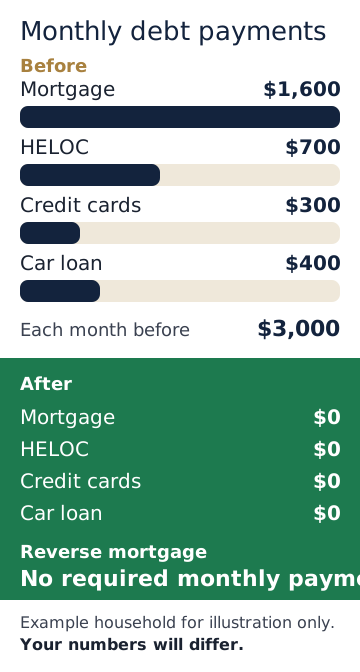
Suppose you have a mortgage balance, a HELOC, credit card debt or a car loan. A HELOC, or home equity line of credit, is a borrowing limit secured against your home.
When a reverse mortgage is set up, the funds pay off any mortgage or HELOC on the home first, then other balances you choose. Once a debt is fully repaid, its payment stops, and more of your retirement income stays with you.
The debt has been replaced by one loan secured against your home. Interest is added to that balance instead of being paid each month.
No regular monthly mortgage payments are required. You still keep up property taxes, home insurance and upkeep.
That no-payment structure is what frees up your budget. If you already carry a HELOC, see our reverse mortgage vs HELOC comparison. For mortgages and other debts, read using a reverse mortgage to pay off debt in retirement.
What monthly costs remain?
Clearing debt payments makes a real difference, but the costs of living in your home stay. Plan for:
- Property taxes
- Home insurance
- Repairs and regular upkeep
- Strata fees, if you live in a strata home
- Utilities, food, transportation and health costs
- Payments on any debt the reverse mortgage does not repay
Setup costs such as appraisal and legal fees also apply. Ask which are due up front and which can be added to the loan balance.
The impact on your home equity
Home equity is the value of your home minus the debts secured against it. Interest builds on the reverse mortgage over time, which increases what is owed and reduces the equity left.
When the loan comes due, your family can repay the balance and keep the home, or the home is sold and what remains after repayment and sale costs goes to the estate. Talk it over with family so everyone understands the plan. If you also want to know how the money affects OAS or GIS, see reverse mortgages, OAS, GIS and taxes.
Is a reverse mortgage a fit for you?
It is worth exploring if debt payments are pressing on your fixed income and you want to stay in your home. Compare it with a refinance, which needs income qualification and monthly payments, and with selling, which means leaving your home.
Start with a list of your debts: the balance, the monthly payment, and whether each one is secured against your home. Then ask:
- Which debts would the reverse mortgage repay?
- Would any payments continue afterward?
- What fees and legal costs should I expect?
- What could cause the loan to become due?
A calmer month with a clear plan
A reverse mortgage is a cash-flow management tool for BC homeowners. It replaces several required debt payments with one loan that needs no monthly mortgage payment, so your retirement income goes further.
Take the 60-second BC Reverse Mortgage Quiz
Matt Blake, Mortgage Broker (BCFSA Licence MB600487).
BRX Mortgage Inc. (BCFSA Licence X301291).